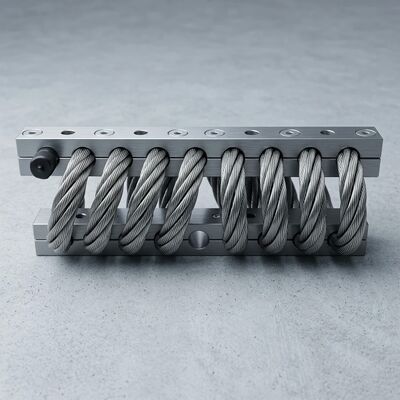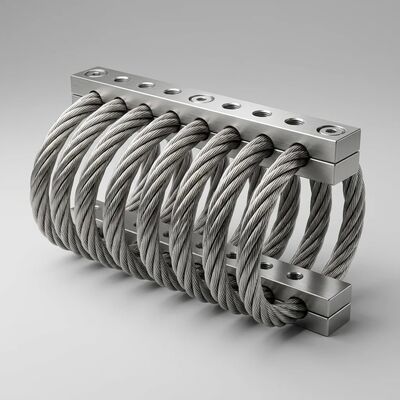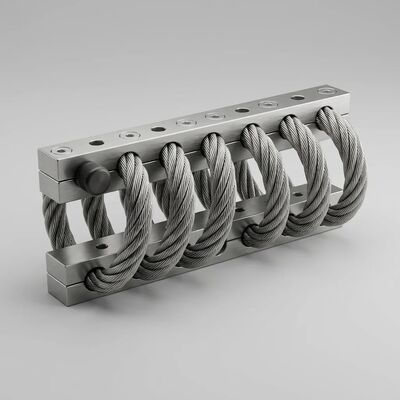
| ब्रांड नाम: | Hoan |
| मॉडल नंबर: | जेजीएक्स-2228डी-1250बी |
| MOQ: | 10 टुकड़े |
| भुगतान की शर्तें: | एल/सी, डी/ए, डी/पी, टी/टी, वेस्टर्न यूनियन |
In vibration engineering, there is a persistent trade-off between damping performance and predictability. Hydraulic dampers offer high, tunable damping coefficients but introduce fluid seals that leak, viscosity that shifts with temperature, and cavitation that creates non-linear force discontinuities. Elastomeric mounts are simple and inexpensive but exhibit stiffness and damping that drift with time, temperature, and strain history—making the isolation system's dynamic response a moving target. The JGX-2228D-1250B resolves this trade-off by anchoring its fail-safe vibration control in a physical mechanism that is simultaneously high-performing and inherently stable: Coulomb friction between steel wires.
The JGX-2228D-1250B's 8.0 mm wire rope is constructed as a 7*19 strand—seven bundles, each containing nineteen individual AISI 316L steel wires, for a total of 133 filaments within a single rope cross-section. When the helix deforms under external vibration, adjacent wires within each strand bundle slide against one another at the microscopic scale. This inter-wire sliding converts kinetic (vibration) energy into heat through dry Coulomb friction.
Key characteristics of this damping mechanism:
Precision deflection control is the engineering discipline of ensuring that when a specific static load is applied, the resulting displacement is predictable—not just from the design equations, but from the actual manufactured unit in the user's hand. The JGX-2228D-1250B achieves ±3% unit-to-unit static deflection variation, verified on every single unit before serialization.
Why this tolerance matters in multi-point mounting systems:
Consider a 2,400 kg compressor skid supported by four JGX-2228D-1250B mounts, each carrying 600 kg static load. At this load, the nominal static deflection is approximately 12 mm. With ±3% tolerance, the worst-case deflection spread across the four mounts is 11.64 mm to 12.36 mm—a maximum mount-to-mount height difference of 0.72 mm. Across a typical 800 mm mount spacing, this produces an angular tilt of approximately 0.05°, which is within the alignment tolerance of nearly all standard flexible shaft couplings (typically 0.25°–1.0° depending on coupling type). The coupling is not the limiting factor; the mounts are precise enough to preserve coupling alignment without shimming.
The manufacturing processes that deliver this consistency:
The static spring rate of the JGX-2228D-1250B is not a single number; it is a curve with three distinct zones determined by the physical state of the wire rope helix under progressive loading:
| Zone | Load Range | Stiffness | Helix State | Design Purpose |
|---|---|---|---|---|
| I: Elastic Bending | 100–300 kg | ~45–90 N/mm | Coils deform elastically; individual wires bend but do not compact | Maximize isolation for light equipment and small-amplitude continuous vibration |
| II: Strand Compaction | 300–800 kg | ~90–270 N/mm | Wires within each strand compact together; inter-wire friction increases progressively | Smooth transition from soft isolation to load-bearing with increasing damping |
| III: Geometric Stiffening | 800–1,200 kg | ~270–545 N/mm | Helix geometry approaches full compaction; coil-to-coil spacing minimizes | Limit deflection to 22 mm under shock/overload without external travel stops |
This progressive curve is the isolator's most valuable dynamic characteristic. During normal operation in Zone I or II, the low dynamic stiffness provides high isolation efficiency—greater than 85% of vibration energy is blocked at frequencies above 1.4* the natural frequency. When a shock event or startup torque transient drives the mount into Zone III, the sudden stiffness increase limits displacement to 22 mm maximum without metal-to-metal contact, fluid bottoming, or elastomer crushing. There are no external snubbers to adjust, no clearance gaps to set, and no supplemental springs to tune. The single helical element handles the full dynamic range.
| Parameter | Value | Test Method |
|---|---|---|
| Transmissibility at Resonance | < 4:1 (1.5–3.5* typical) | Swept-sine base excitation, 2–50 Hz, 0.5g input |
| Isolation Efficiency @ 1.4* fn | > 60% | Force transmissibility measurement |
| Isolation Efficiency @ 2* fn | > 85% | Force transmissibility measurement |
| Maximum Shock Input | 25g, 11 ms Half-Sine | IEC 60068-2-27, 3 pulses per axis |
| Dynamic/Static Stiffness Ratio | 1.1–1.3 | Dynamic stiffness @ 0.5 mm amplitude, 5–20 Hz |
| Fatigue Life (S-N) | > 2 * 10² cycles @ ±0.5 mm amplitude | Constant-amplitude sinusoidal, 10 Hz, rated static preload |
| Damping Ratio Stability | < ±5% deviation over 10² cycles | Periodic damping measurement during fatigue test |
| Parameter | Value |
|---|---|
| Model | JGX-2228D-1250B |
| Wire Rope | AISI 316L Stainless Steel, 8.0 mm Ø, 7*19 (133 Wires) |
| Clamp Material | 6061-T6 Aluminum Alloy, Hard Anodized 25 μm |
| Coil Configuration | 10 Coils, Symmetrical Double-Helix |
| Dimensions | 210 mm (L) * 120 mm (W) * 95 mm (H) |
| Mass | 3.20 kg |
| Mounting | 4* Ø12.5 mm Through-Holes, Accept M12 Fasteners |
| Static Load Range | 100–1,200 kg per Mount |
| Max Deflection | 22 mm (Compression Axis at Rated Load) |
| Deflection Tolerance | ±3% Unit-to-Unit (100% Verified) |
| Static Spring Rate | 45–545 N/mm (Progressive, 3-Zone) |
| Natural Frequency | 4–12 Hz (Load-Dependent) |
| Damping Ratio | ζ = 0.15–0.25 |
| Damping Type | Coulomb (Dry) Friction, 133 Parallel Interfaces |
| Transmissibility @ fn | < 4:1 (1.5–3.5* typical) |
| Isolation Efficiency @ 2* fn | > 85% |
| Max Shock Input | 25g (11 ms Half-Sine, 3 Pulses per Axis) |
| Dynamic/Static Stiffness | 1.1–1.3 (0.5 mm Amplitude, 5–20 Hz) |
| Operating Temperature | -40°C to +180°C (Continuous) |
| Fatigue Life | > 2 * 10² Cycles at Rated Static Load |
| Surface Finish | Wire Rope: Electropolished Ra ≤ 0.4 μm; Clamps: Anodized 25 μm |
| Certifications | ISO 9001:2015, CE, RoHS, REACH |
Most elastomeric isolators have a dynamic-to-static stiffness ratio of 1.5–2.5, meaning the mount is 50–150% stiffer under vibration than under static load. This complicates isolation system design because the natural frequency during operation (which determines isolation effectiveness) is higher than the simple static calculation predicts. The JGX-2228D-1250B's ratio of 1.1–1.3 is among the lowest achievable without active control, because Coulomb friction between metallic surfaces exhibits far less strain-rate sensitivity than the viscoelastic deformation of rubber polymers. When an engineer calculates the natural frequency from the static load-deflection curve, the operating natural frequency will be within approximately 5–15% of the predicted value—an accurate starting point rather than a coarse estimate.
Each JGX-2228D-1250B is supplied with its individual load-deflection test curve (digital or printed, per customer preference), the 316L heat certificate per EN 10204 3.1, the 6061-T6 billet certificate, and the anodizing batch log. All documents are keyed to the laser-etched serial number on the clamp body. This documentation set supports regulatory compliance audits, customer incoming inspection, and equipment qualification programs in industries including power generation, oil and gas, and marine classification society approval processes.